AI made it dramatically easier to produce video ads.
It did not make it dramatically easier to produce persuasive ones.
That is the real problem small businesses are running into in 2026. The tools are faster. The outputs are cleaner. The barrier to making something that looks like an ad has collapsed. But the barrier to making something that actually earns attention, builds trust, and gets someone to click or buy is still very real.
And that gap matters now because the category is moving fast. On April 28, 2025, IAB reported that U.S. digital video ad spend hit $64B in 2024 and was projected to reach $72B in 2025. On July 15, 2025, IAB also reported that 86% of buyers were already using or planning to use generative AI to build video ad creative.
So yes, AI video ads are becoming normal. But "normal" does not mean "trusted," and it definitely does not mean "effective."
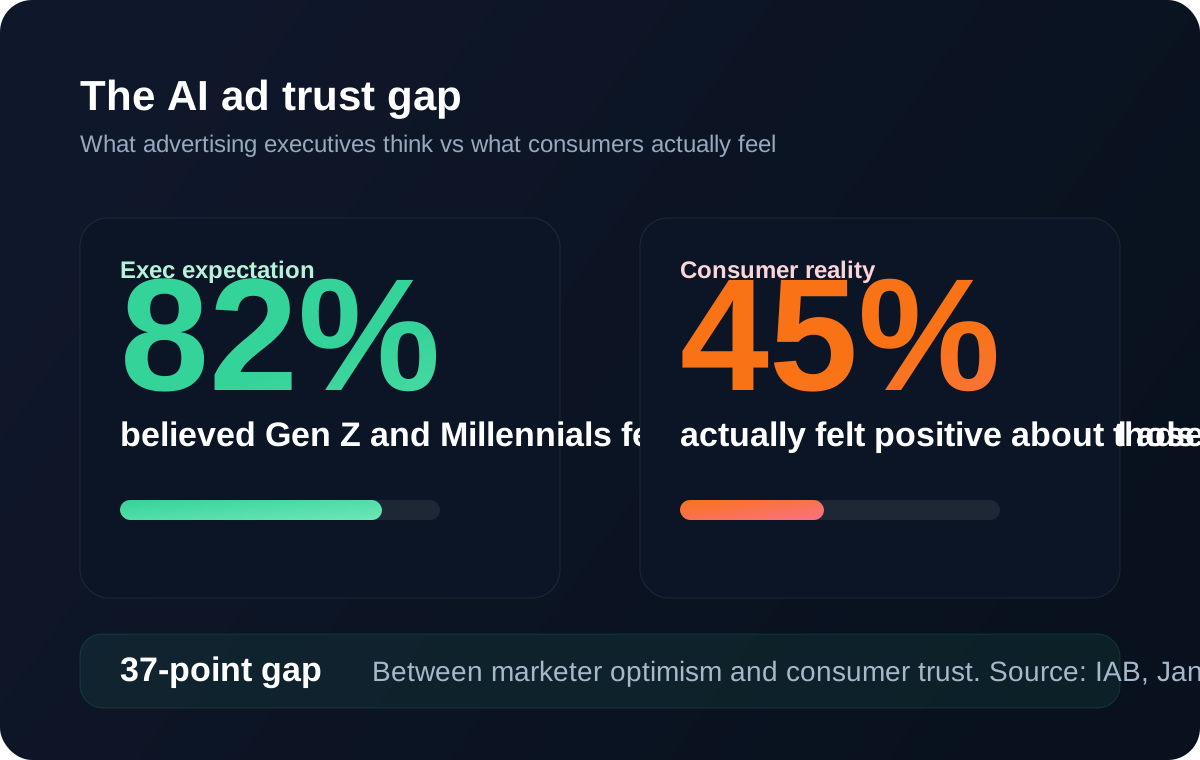
On January 15, 2026, IAB found a widening trust gap: 82% of ad executives believed Gen Z and Millennial consumers felt positive about AI-generated ads, while only 45% of consumers actually felt that way. Among Gen Z, negative sentiment was even stronger.
That is the tension this article is built around:
AI lowered the cost of producing ads. It did not lower the standard for convincing people.
If you are a small business making your own AI video ads, the biggest mistake is assuming the tool is the strategy. It is not. The ads that convert usually win because they get to the point fast, feel specific instead of generic, show a real problem, show a believable solution, and end with a clear offer.
The Quick Answer
If you only need the short version, here it is:
- Most AI video ads fail for human reasons, not technical ones. The problem is usually weak messaging, weak structure, weak proof, or weak editing judgment.
- You have only a few seconds to earn attention. If the opening frame and opening line do not create curiosity or relevance fast, the rest of the ad does not get a chance.
- People are increasingly sensitive to low-effort AI creative. They may not know which model made it, but they recognize the signs of generic, synthetic, over-smoothed advertising quickly.
- Authenticity matters more than polish. HubSpot's 2024 Consumer Trends Report says 63% of consumers think marketing videos should be more authentic than polished. Source.
- The best structure for most small-business ads is simple: hook, pain point, solution, proof, offer, CTA.
- The right tool depends on the job. Avatar tools, template tools, diffusion-style generators, and flexible ad builders solve different problems.
Everything else in this guide is about how to execute those points well enough that the ad can actually perform.
Why AI Video Ads Still Feel Hard
Small businesses often assume they are struggling with AI because they are "not good at prompting."
Usually that is not the real issue.
The real issue is that advertising compresses a lot of difficult work into a tiny space:
- you have to stop attention fast
- you have to make the message instantly legible
- you have to look trustworthy before you look salesy
- you have to make the product feel relevant to a real pain point
- you have to show enough proof to avoid sounding inflated
- you have to end with a next step that feels worth taking
AI can accelerate production of assets. It cannot magically do your positioning, judgment, or persuasion for you.
This is one reason so many first-draft AI ads feel impressive for five seconds and useless for the next fifteen. They often have motion, effects, transitions, and "marketing words," but they do not have a coherent argument.
Google's own guidance makes clear that creative quality matters enormously. According to the source it cites, creative is responsible for 49% of the total sales impact of advertising. That should reframe the whole conversation. The creative itself is not decoration around performance. It is a major driver of performance.
For a small business, that means the job is not simply to "make a video." The job is to make a clear sales argument in video form.
The Attention Deadline Index
Here is one original synthesis worth keeping in mind.
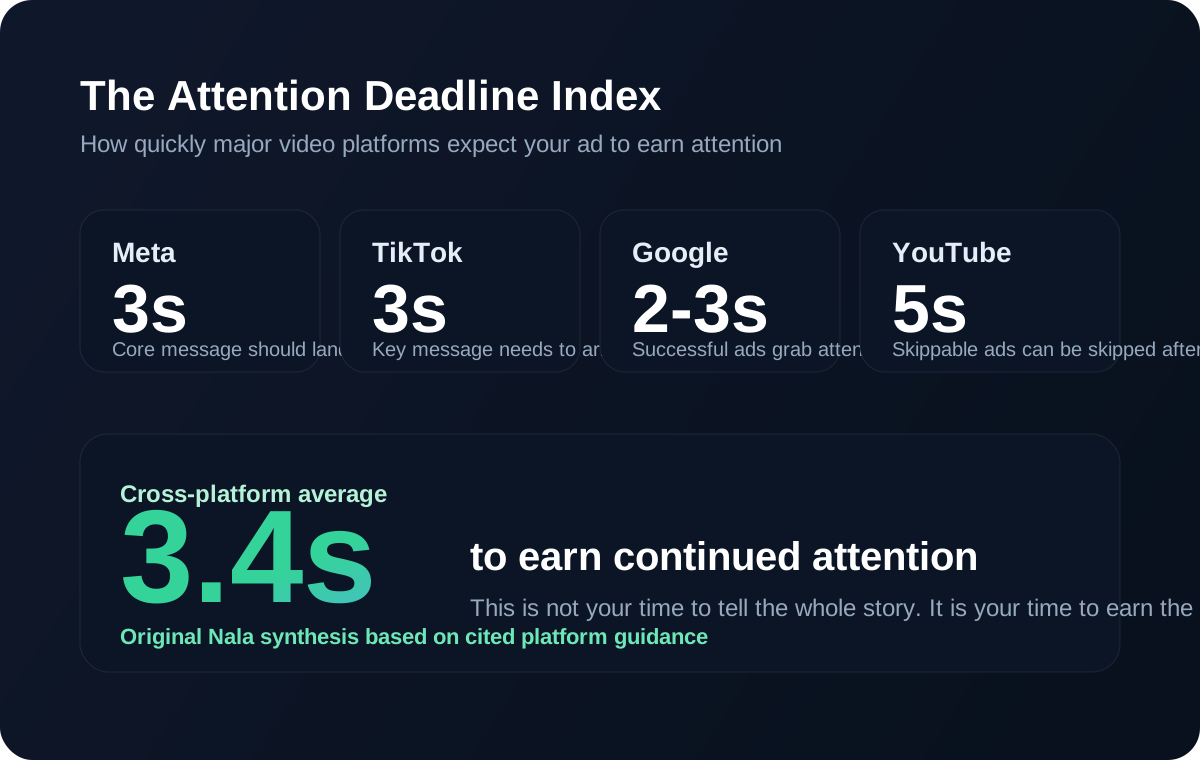
Using official platform guidance from Meta, TikTok, Google, and YouTube, the window for earning continued attention is extremely short:
- Meta repeatedly emphasizes the first 3 seconds for video ad impact and message delivery. Source
- TikTok advises advertisers to communicate the key message in the first 3 seconds. Source
- Google's mobile app video guidance says successful ads typically capture attention in about 2 to 3 seconds. Source
- YouTube skippable in-stream ads can be skipped after 5 seconds. Source
If you take those benchmarks together, the cross-platform average works out to about 3.4 seconds.
The Attention Deadline Index: For most modern video ad environments, you have roughly 3.4 seconds to earn continued attention. Not to tell the whole story. Just to earn the right to keep telling it.
That changes how you should build the ad.
It means the first screen cannot be a vague logo animation, a cinematic mood shot, or a slow "Hi guys, so today I want to talk about..." opener. It needs to create immediate relevance.
For small businesses, that usually means one of four things in the opening:
- a direct pain point
- a specific outcome
- a surprising claim
- a clear before-and-after tension
Why People Reject "AI Slop"
People do not sit there consciously grading whether a video was made with AI.
What they do notice is whether the ad feels lazy, generic, fake, or emotionally hollow.
That is what many people mean when they talk about "AI slop." It is not just machine-made content. It is content that feels frictionlessly produced and therefore frictionlessly ignored.
The data points line up with this:
- HubSpot says 63% of consumers care more about video being authentic than polished.
- IAB says Gen Z and Millennial consumers are far less positive about AI-generated ads than advertisers assume.
- The same IAB study found that Gen Z respondents were much more likely than Millennials to describe AI-using brands as inauthentic, disconnected, or unethical.
That does not mean businesses should avoid AI. It means they should avoid the recognizable symptoms of bad AI creative:
- generic script openings
- claims with no proof
- stock-looking visuals that could belong to any brand
- too many scenes with no message hierarchy
- fake urgency that no real person would say
- voiceover that sounds detached from the product
- ads that feel "generated" instead of intentional
Consumers may not know your workflow, but they do have a mental filter for content that feels mass-produced, over-automated, or emotionally unconvincing. In practice, that is the filter your ad has to beat.
If you want your AI video ad to convert, the goal is not to hide the fact that you used AI. The goal is to use AI in a way that still produces clarity, specificity, taste, and trust.
The 6-Part Framework That Actually Works
For most small businesses, the simplest reliable structure is still the best one:
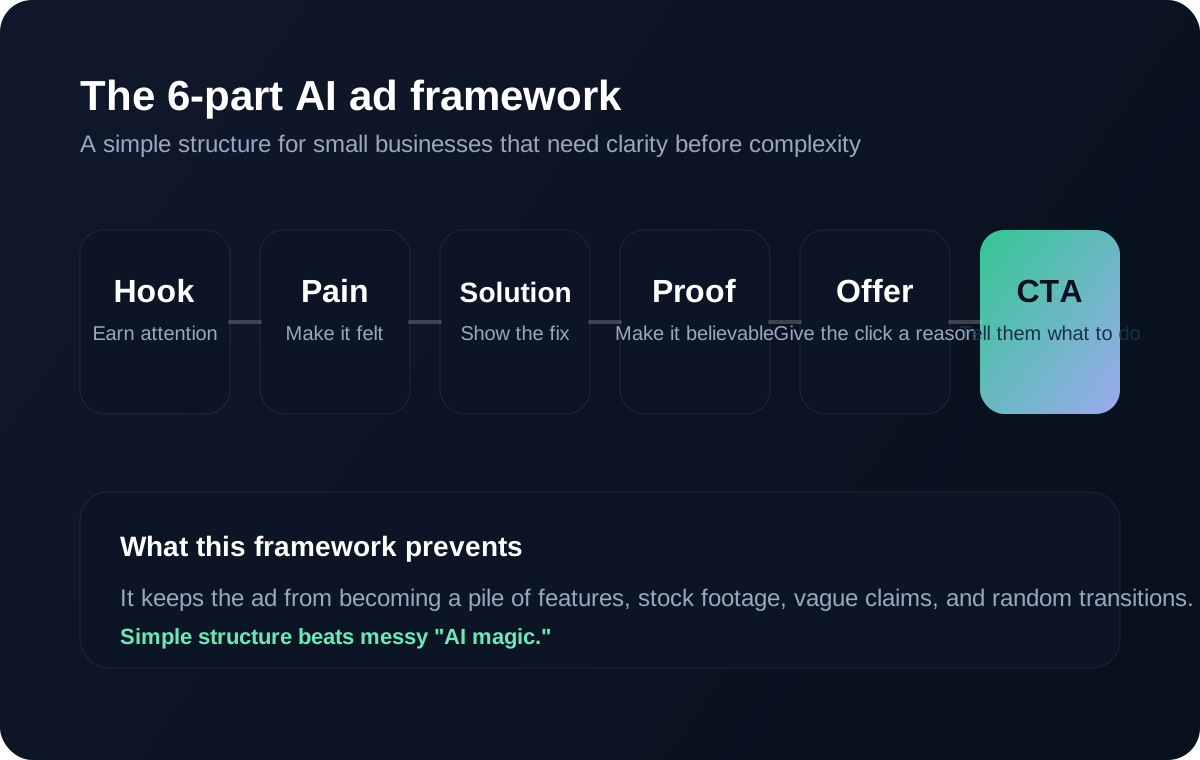
Here is what each part should do.
1. Hook
The hook should make the right person feel, "this might be for me."
Good hooks are usually specific, not dramatic. For example:
- "Still spending hours making one ad at a time?"
- "Your product page might already have enough material for three better ads."
- "Most skincare ads show the product. The better ones show the frustration."
Weak hooks are usually broad and self-centered:
- "Welcome to our brand"
- "We are excited to introduce..."
- "The future of advertising is here"
2. Pain
Show the problem in a way the viewer recognizes instantly. This is where a lot of AI ads stay too abstract. They say "save time" or "grow your business" without dramatizing the actual friction.
Good pain is concrete:
- too many manual edits
- low-performing ads that all look the same
- customers dropping off before understanding the offer
- spending money on traffic that never reaches a convincing message
3. Solution
The solution should feel like a direct answer to the pain, not a product dump. This is where small businesses often over-explain. Do not try to describe every feature. Show the most relevant mechanism.
4. Proof
This is where weak AI ads often collapse.
Proof can be:
- a real product demo
- a before-and-after
- a testimonial
- a customer quote
- a believable statistic
- a visual showing what changed
If the ad has no proof, it often sounds like generated optimism.
5. Offer
Tell the viewer what they actually get now. Small businesses often assume the CTA is enough. It is not. The offer is what makes the CTA worth clicking.
Examples:
- "Get 20% off your first order"
- "Book a free strategy call"
- "Start with a free plan and create your first ad"
6. CTA
Make the next step explicit. Not "learn more if interested." Not "check us out." Say what to do.
Better: Start free. Book a demo. Claim the offer. See pricing. Watch the full demo.
A Simple Workflow to Make Your First AI Video Ad
If you searched for "how to create AI video ads," you probably do not just want theory. You want a sequence you can actually follow.
For most small businesses, this is the cleanest version of that process:
- Choose one audience and one offer. Do not start with "everyone." Start with one buyer, one problem, and one next step.
- Write the opening before you write the full ad. The first line, first frame, and first on-screen text should carry the heaviest strategic load.
- Collect proof before generating anything. Pull together the product demo, screenshots, customer quote, review, before-and-after, or founder clip that will make the claim believable.
- Pick the right input workflow. Start from text when the concept is clear, from a product URL when the page already contains the offer and positioning, and from an image when the visual asset is the strongest part of the ad.
- Generate one draft, then make three strategic variants. Change the hook, proof angle, or CTA. Do not waste your test on tiny color swaps.
- Check the ad on a phone and on mute. If the first screen is not readable, understandable, and visually clear on mobile, it is not ready.
- Launch small and diagnose the drop-off. Watch where the ad loses people before you spend time polishing the wrong section.
If you cannot state the audience, pain point, proof, and offer in one sentence each, you are not ready to generate the ad yet.
For teams choosing the right starting point, it also helps to read our guides on URL-to-video workflows, AI video prompting, and image-to-video ads.
A Copy-and-Paste Brief Template
Good AI video ads get easier when the brief gets sharper. Use this before you open the tool:
Audience:
Core problem:
Product or service:
Primary claim:
Proof:
Offer:
Desired CTA:
Placement:
Aspect ratio:
Must-show visuals:
Must-avoid words or visuals:
Three hook ideas:
That template is simple on purpose. It forces the ad to be about a buyer, a claim, and a reason to believe, not just a collection of scenes.
Beginner Ad vs Better Ad
This is where the difference becomes obvious.
Example 1: A beginner ecommerce ad
How beginners often do it:
"Introducing our new hydrating serum. It is made with premium ingredients and designed to give your skin the glow it deserves. Shop now and experience the difference."
Why it underperforms:
- the opening is generic
- there is no real pain point
- "premium ingredients" means almost nothing on its own
- there is no proof, demonstration, or tension
- it sounds like every other beauty ad
A stronger version:
"If your skin feels tight by 3 p.m., your moisturizer may not be doing enough. This serum was built for dry, stressed skin that needs to stay comfortable all day. See the texture, see the finish, then get 15% off your first order."
Why it is better:
- the hook is specific
- the pain feels familiar
- the product is framed as a solution, not just an object
- the ad naturally invites a visual demo
- the offer gives the click a reason
Example 2: A beginner service-business ad
How beginners often do it:
"We help small businesses with bookkeeping, payroll, and financial organization. Our team is professional, experienced, and here to support your growth."
Why it underperforms:
- too broad
- nothing creates urgency or recognition
- it describes the business, but does not enter the customer's reality
- it sounds safe rather than useful
A stronger version:
"Still guessing whether your business was actually profitable this month? We help small businesses clean up bookkeeping, payroll, and reporting so you can stop making decisions in the dark. Book a free review and leave with a clearer picture of your numbers."
Why it is better:
- it starts with a live business pain point
- the service sounds practical, not abstract
- the benefit is concrete
- the CTA feels tied to a real next step
The difference in both examples is not that the second version uses more adjectives. It uses more relevance.
The Creative Rules That Matter Most in 2026
There are dozens of tips you could follow. These are the ones that matter most.
1. Build the first frame like it has to survive on mute
A lot of video inventory is effectively silent first. That means the visual and the on-screen copy need to carry meaning immediately, even before a voiceover has time to help.
2. Keep one message per ad
Many small businesses try to cram the product, brand story, testimonials, offer, features, founder vision, and seasonal promo into one video. That usually weakens all of them.
One ad should carry one main job.
3. Do not let more than a few seconds pass without a reason to keep watching
This does not mean random movement. It means something meaningful should change: the framing, the visual, the proof, the copy, the promise, or the question being answered.
Google's mobile video guidance points to faster-engaging creative, and HubSpot's 2024 video marketing report says marketers see the first few seconds, engaging editing, and engaging storytelling as the most important ingredients in effective video. Source.
4. Use authenticity as a creative advantage
Authentic does not mean sloppy. It means believable.
For many businesses, this can mean:
- showing the real product in use
- showing a founder, team member, or customer
- using clearer, more natural language
- showing behind-the-scenes context
- avoiding claims that sound inflated or over-produced
This is one reason overly glossy AI creative can underperform. The problem is not beauty. The problem is distance. The viewer does not feel there is a real person, a real problem, or a real promise behind the ad.
5. Design for mobile comprehension, not desktop admiration
Readable type, clear whitespace, strong contrast, clean hierarchy, and safe-zone awareness matter more than ornamental complexity. A cluttered ad can be "high effort" and still fail.
6. Match the proof to the claim
If the ad claims speed, show speed. If it claims simplicity, show simplicity. If it claims a better result, show the result. The proof should answer the claim, not just decorate it.
7. Make variants by changing strategy, not just color
Many advertisers say they are testing multiple ads when they are really testing the same ad with tiny cosmetic changes. Better tests usually change one major variable:
- the hook
- the pain point
- the proof angle
- the offer framing
- the CTA wording
Which Type of AI Video Tool Fits Which Business
People talk about AI video tools like they are all one category. They are not. For small businesses, there are at least four practical buckets.
| Tool Type | Best For | Main Strength | Main Limitation |
|---|---|---|---|
| Diffusion / raw generation tools | Eye-catching footage, concept visuals, mood clips | Can create unique visual material fast | Usually not the cleanest route to a finished ad with a clear offer and CTA |
| Avatar tools | Explainers, founder-style messaging, training, direct-to-camera delivery | Useful when a face and spoken explanation carry trust | Can feel repetitive or synthetic when every ad becomes a talking head |
| Template tools like Canva or CapCut | Fast promos, simple edits, teams that already know the structure they want | Speed and manual control | Easy to produce ads that look like everybody else's templates |
| Flexible AI ad builders | Businesses that need faster iteration with stronger control over the message and edit path | Better fit for revising hooks, product framing, layouts, and variants without starting over | Requires clearer direction than a one-click template workflow |
That last category is where tools like Nala Studio fit.
The right tool depends on what is supposed to carry the ad.
- If the face is the message, start with avatars or real-person footage.
- If the product and offer are the message, start with a motion-graphics-first or mixed-media workflow.
- If you already know the exact structure, templates may be enough.
- If you need better revisions, more specific edits, and more strategic control, a flexible ad builder will usually fit better.
For a deeper comparison of categories, it also helps to read our guides on AI ad makers, best AI video tools, and Facebook video ad creators.
How to Judge Whether the Ad Is Working
If the headline says "actually convert," we need to be honest about what that means.
You should not judge the ad by whether it looks modern, expensive, or technically impressive. Judge it by whether it improves the right metrics.
For most small businesses, the useful stack looks like this:
- Early attention: Are people even staying for the opening seconds?
- Engagement or hold quality: Are they continuing long enough to receive the offer?
- Click-through rate: Does the creative motivate curiosity or intent?
- Landing-page conversion rate: Does the promise in the ad survive contact with the page?
- CPA and ROAS: Is the campaign economically worth continuing?
That progression matters because a lot of teams blame the ad for a landing-page problem, or blame the platform for a weak offer.
The cleaner way to think about it is:
- if nobody watches, your hook is weak
- if people watch but do not click, your message or offer is weak
- if people click but do not convert, the page or the offer may be weak
Do not ask only, "Is this a good ad?" Ask, "Where exactly is the ad losing the customer?" That question leads to better revisions much faster.
Frequently Asked Questions
Do AI video ads actually convert?
They can, but AI is a production multiplier, not a persuasion shortcut. The ads that convert usually have a strong hook, one clear message, visible proof, a real offer, and a revision process that improves weak drafts instead of publishing generic first outputs.
Why do so many AI video ads feel fake?
Most weak AI ads fail for recognizable reasons: generic hooks, vague claims, no proof, stock-looking visuals, repetitive pacing, and copy that sounds like it was written for everyone. Consumers may not identify the exact tool, but they often recognize the symptoms of low-effort creative immediately.
How long should an AI video ad be?
There is no universal length, but most small businesses should optimize for clarity in the opening seconds rather than length for its own sake. If the ad has not earned attention quickly, the extra seconds usually do not help.
What is the best AI video ad format for small businesses?
For most small businesses, the best format is the one that makes the offer and the product clear fastest. Product-led brands often benefit from motion graphics or mixed-media ads. Service businesses often benefit from real people, customer proof, or direct explanation.
Are avatar tools better than template tools or AI generators?
None is universally better. Avatar tools are strongest when a face or explanation needs to carry the message. Template tools are strongest when you already know the structure and want manual control. AI generators and flexible ad builders are strongest when you need speed, iteration, and multiple variations from limited source material.
What should I measure after launching an AI video ad?
Start with early attention and response signals: hold rate in the first seconds, click-through rate, landing-page conversion rate, cost per acquisition, and return on ad spend. A polished ad is not necessarily a useful ad if it does not improve those numbers.
Where Nala Studio Fits
Nala Studio is not an avatar-only product, and it is not just a template editor with AI sprinkled on top.
It fits best when a business wants to turn a brief, a product page, an image, or an idea into a real ad draft and then keep refining the actual structure of the ad instead of being locked into one template pattern.
That matters when you need to change things that actually move performance:
- the hook
- the scene order
- the copy hierarchy
- the product emphasis
- the CTA
- the aspect-ratio version
For small businesses, that is often more valuable than just generating a flashy first draft. The first draft is not the hard part anymore. The hard part is getting to a version that feels clear, specific, and testable.
If your workflow starts from text, a product URL, or an image and your biggest need is faster iterations with more control, that is where Nala tends to make sense.
The Final Take
The future of AI video ads is not "press a button and conversions appear."
The future is faster production paired with better creative judgment.
That is good news for small businesses, because it means the advantage does not automatically go to the team with the biggest studio or the most expensive editor. It goes to the team that understands the customer clearly enough to make a sharper ad.
So if you want the simplest useful takeaway from this whole guide, make it this:
Do not ask AI to make you an ad. Ask it to help you make a clearer sales argument, faster.
That is the mindset that turns AI from a novelty into a real conversion tool.
And if you are deciding what kind of workflow to use next, start by asking four questions:
- What pain point should this ad open with?
- What proof will make the claim believable?
- What single offer is this ad trying to sell?
- What tool will make revising those things easiest?
Answer those well, and you will be ahead of most AI ad creative already in the market.
Source Notes
This guide is built from primary platform guidance, industry research, and the real structural questions small teams run into when they turn a brief, product page, or image into ad creative. The strongest cited data points come from primary or first-party sources:
- IAB, April 28, 2025: U.S. digital video ad spend reached $64B in 2024 and was projected at $72B in 2025.
- IAB, July 15, 2025: 86% of buyers were using or planning to use generative AI to build video ad creative.
- IAB, January 15, 2026: 82% of ad executives believed younger consumers felt positive about AI-generated ads, while only 45% of consumers actually did.
- HubSpot Consumer Trends Report 2024: 63% of consumers say it is more important for marketing videos to be authentic than polished.
- HubSpot Video Marketing Report 2024: marketers cite the first few seconds, engaging editing, and engaging storytelling as leading drivers of effective video content.
- Google Ads creative performance guidance: creative is responsible for 49% of sales impact, and including horizontal, vertical, and square video assets drove 20% more YouTube conversions than horizontal alone.
- Google Ads mobile app video guidance: successful ads tend to capture attention in about 2 to 3 seconds.
- Google Ads skippable in-stream specs: YouTube skippable ads can be skipped after 5 seconds.
- TikTok for Business creative guidance: key messages should land early, especially in the first 3 seconds.
- Meta guidance: video creative should deliver core messaging and branding in the first 3 seconds.
One original synthesis in this article is the Attention Deadline Index, which averages those platform attention thresholds to estimate that brands have roughly 3.4 seconds to earn continued attention across modern video-ad environments. That is our own calculation based on the cited platform guidance above.